Platanistasa
Type: Watermill
District: Nicosia
Village: Platanistasa
River: Platanistasa river
Location - Toponym: Mylos
Cadastral Info: Sheet/Plan: 29/47 E2; Plot: 282
-thumb.jpg)
Mill Description
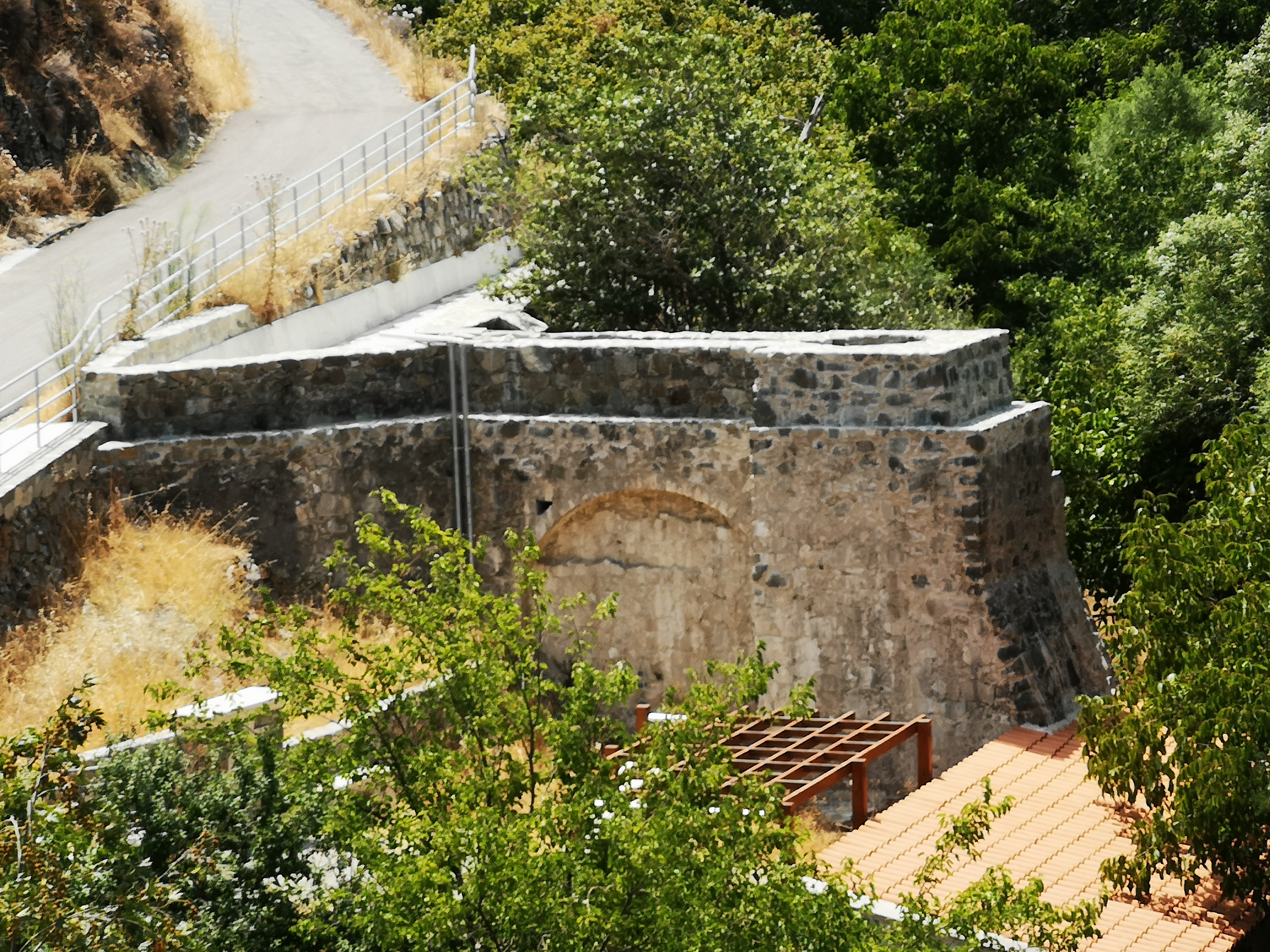
The mill is built on steeply sloping ground on the east side of the Platanistasa river, among orchards with fruit trees. The surviving buildings of the mill include the aqueduct, the water reservoir, the watertower and the building that housed the grinding mechanism. The stonebuilt aqueduct is preserved at a length of about 200m, from the river to the mill. The water channel follows the configuration of the rocky landscape and its width is ranging from 0.50 -1.20m and is constructed parallel to the riverbed. It is also used as an irrigation channel and along its length there are openings for the diversion of the water (dishies) for the irrigation of the trees. The stonebuilt water channel ends in a large elongated water reservoir from which water is drained to the watertower. The watertower is a monumental structure with a maximum height of 8.50m. It has a square plan at the top and an inclined form on the front (northern) side. The aqueduct between the reservoir and the watertower is compact and formed by two blind arches. The masonry is made of river stones mixed with smaller stones and rich binding lime mortar. The shaft has the shape of an inverted truncated cone with a diameter in the upper part of 1.50m. On the lower level of the watertower and in contact with its front (north) side there is the building that housed the grinding mechanism. It is an elongated, approximately rectangular room (makrynari) with dimensions 4 x 14m. Its walls follow the irregular stone wall technique with river stones and lime mortar. Under the west end of the building there is the vaulted room that housed the waterwheel. All elements of the kinetic and grinding mechanism were almost fully preserved. The millstones originate from the island of Milos and are placed on the floor of the mill. They have a diameter of 1.20m and each consists of several pieces connected by metal rings (vrashioles). The waterwheel is wooden with a central axis and 38 paddles. The construction of the mill dates back to the late Ottoman period, perhaps to the 18th century. The mill was owned by the church of Archangelos in Platanistasa for more than a century, at least from the 1830s until 1952 when it was sold. In the codes of the village’s church, repair works are recorded from 1833 onwards. The church of Archangelos rented the watermill to private individuals, usually on an annual basis, but took care of its repair and maintenance from time to time. In 1952 the church sold the mill to a private owner from Platanistasa, who operated it until 1961. In 1977 the mill was sold to another private owner and in 1996 it was declared a listed monument. In 2005 the mill was bought by the Co-operative Savings Society of Pitsilia, which in turn leased the mill to the Community Council of Platanistasa for 33 years. Restoration and protection of the mill by the Council, was a fundamental provision of the leasing agreement. Upon completion, the mill would become the council’s property. During the years 2018-19 the repair works of the mill’s complex were completed. The works included the repair and restoration of the mill building, the watertower, the water reservoir and the stonebuilt water channel, as well as the grinding and kinetic mechanisms. The interior space was arranged to exhibit several items of the mill. In addition, the stonebuilt arched bridge, which is located in a very close distance to the mill, was restored while the surrounding space was rearranged. According to a folktale, the two neighboring villages of Platanistasa and Alona and by extension their patron saints, Archangel Michael and Saint George respectively, were fighting for the ownership of the mill. The two of them decided to start a competition by running to the mill and the winner would become the mill’s owner. The Archangel spread his wings and the Saint rode his horse and rushed towards the mill. The Archangel arrived first with a flight and thus the mill became the property of Platanistasa. When Saint George came second, the Archangel who blinked his wings, frightened the horse that stepped with force and left its imprint on a rock. D. Myrianthefs
Photos
.JPG)
D. Myrianthefs Platanistasa (1).JPG
.jpg)
D. Myrianthefs Platanistasa (2).jpg
.JPG)
D. Myrianthefs Platanistasa (3).JPG
.jpg)
D. Myrianthefs Platanistasa (4).jpg
.JPG)
D. Myrianthefs Platanistasa (5).JPG
.JPG)
D. Myrianthefs Platanistasa (6).JPG
.JPG)
D. Myrianthefs Platanistasa (7).JPG
.JPG)
D. Myrianthefs Platanistasa (8).JPG
.jpg)
Platanistasa G. Economides (2).jpg