Agios Ioannis Malountas (1st mill, Tou Vartali)
Type: Watermill
District: Nicosia
Village: Agios Ioannis Malountas
River: Akaki River
Location - Toponym: Vartalis
Cadastral Info: Sheet/Plan: 29/47 E2; Plot: 282
Mill Description
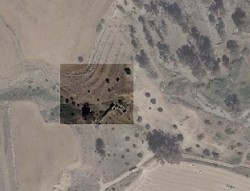
The mill is built on relatively flat ground on the west side of the Akaki river, in fields with sparse trees and limited crops. The surviving buildings of the mill include the aqueduct, the watertower and the dilapidated building that housed the grinding mechanism. Water for the operation of the mill was directed by means of a water channel that was dug out of the earth, starting from the river, at about 1.5km away from the mill. The stonebuilt aqueduct is an impressive structure, 24m long. The aqueduct has a solid base for a long distance where close to the tower is formed by two arches, one semicircular and one segmental. In its upper part there is a channel, 0.56m wide, which is plastered. It is built with the irregular stone wall technique with river stones and gravel while its arches are built of dressed limestone. The aqueduct’s masonry is in a relatively good state, while subsidence and cracks are observed in the arches. The watertower is a massive construction with a maximum height of 8.30m. It is square in plan and on the front (northern) side it has a stepped shape. Its masonry is following the irregular stone wall technique with pebbles and gravel while its cornerstones are made of dressed limestone. The opening of the shaft of the watertower is cylindrical with a gradual decrease of its diameter at the bottom. Its plaster coating is largely preserved.The building that housed the grinding mechanism, which is today in a ruinous state, is placed in contact with the north side of the lower part of the watertower. It is a rectangular room (makrynari) with dimensions 5,50 x16 m. It originally had four transverse pointed arches of which three are preserved. Its walls are made of irregular river stones with plenty of limestone gravel, following the traditional architecture of the area. The arches, the perimeter and the cornerstones are made of dressed limestone. The roof structure was made of wooden beams (volitzia) reeds, a layer of mud and traditional tiles. The western part of the building has collapsed and the rest is about to collapse. In contact with its south side there was a second auxiliary room which had collapsed. The vaulted room that housed the waterwheel is today bogged down by debris. From the kinetic mechanism only the metal axis of the waterwheel is preserved. The grinding mechanism consists of two pairs of millstones placed on a wooden, table like, structure (trapezia). The movement from the kinetic to the grinding mechanism was done by belt wheels and a belt. The millstones are of French origin (La Fertè -sous-Jouarre, Société générale Meuliere).Possible date of construction or repair is 1841. The date was engraved in an overflow gutter of the aqueduct. It seems that it was owned by the Archbishopric of Cyprus since a register of 1856 mentions expenses for the repair of the mill. In 1868 the income from renting the mill is mentioned in a register of the Archbishopric. In 1906 and 1916 a process of renting the mill from the Archbishopric to private individuals was recorded. In 1918 a register of the Archbishopric records a sale process which takes place in 1923 or 1927. According to the current owner, the operation of the mill stopped in 1948. In 1979 it was declared an Ancient Monument of Table B. D. Myrianthefs
Photos
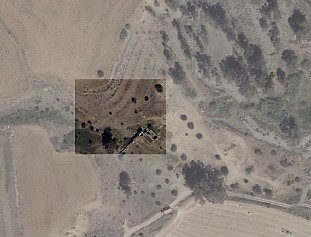
Aerial photograph.jpg
-The-Photographic-Archive-of-the-Cyprus-Department-of-Antiquities-(1).JPG)
Agios Ioannis Malountas (tou Vartali) The Photographic Archive of the Cyprus Department of Antiquities (1).JPG
-The-Photographic-Archive-of-the-Cyprus-Department-of-Antiquities-(10).JPG)
Agios Ioannis Malountas (tou Vartali) The Photographic Archive of the Cyprus Department of Antiquities (10).JPG
-The-Photographic-Archive-of-the-Cyprus-Department-of-Antiquities-(11).JPG)
Agios Ioannis Malountas (tou Vartali) The Photographic Archive of the Cyprus Department of Antiquities (11).JPG
-The-Photographic-Archive-of-the-Cyprus-Department-of-Antiquities-(12).JPG)
Agios Ioannis Malountas (tou Vartali) The Photographic Archive of the Cyprus Department of Antiquities (12).JPG
-The-Photographic-Archive-of-the-Cyprus-Department-of-Antiquities-(13).JPG)
Agios Ioannis Malountas (tou Vartali) The Photographic Archive of the Cyprus Department of Antiquities (13).JPG
-The-Photographic-Archive-of-the-Cyprus-Department-of-Antiquities-(14).JPG)
Agios Ioannis Malountas (tou Vartali) The Photographic Archive of the Cyprus Department of Antiquities (14).JPG
-The-Photographic-Archive-of-the-Cyprus-Department-of-Antiquities-(2).JPG)
Agios Ioannis Malountas (tou Vartali) The Photographic Archive of the Cyprus Department of Antiquities (2).JPG
-The-Photographic-Archive-of-the-Cyprus-Department-of-Antiquities-(3).JPG)
Agios Ioannis Malountas (tou Vartali) The Photographic Archive of the Cyprus Department of Antiquities (3).JPG
-The-Photographic-Archive-of-the-Cyprus-Department-of-Antiquities-(4).JPG)
Agios Ioannis Malountas (tou Vartali) The Photographic Archive of the Cyprus Department of Antiquities (4).JPG
-The-Photographic-Archive-of-the-Cyprus-Department-of-Antiquities-(5).JPG)
Agios Ioannis Malountas (tou Vartali) The Photographic Archive of the Cyprus Department of Antiquities (5).JPG
-The-Photographic-Archive-of-the-Cyprus-Department-of-Antiquities-(6).JPG)
Agios Ioannis Malountas (tou Vartali) The Photographic Archive of the Cyprus Department of Antiquities (6).JPG
-The-Photographic-Archive-of-the-Cyprus-Department-of-Antiquities-(7).JPG)
Agios Ioannis Malountas (tou Vartali) The Photographic Archive of the Cyprus Department of Antiquities (7).JPG
-The-Photographic-Archive-of-the-Cyprus-Department-of-Antiquities-(8).JPG)
Agios Ioannis Malountas (tou Vartali) The Photographic Archive of the Cyprus Department of Antiquities (8).JPG
-The-Photographic-Archive-of-the-Cyprus-Department-of-Antiquities-(9).JPG)
Agios Ioannis Malountas (tou Vartali) The Photographic Archive of the Cyprus Department of Antiquities (9).JPG
.JPG)
Agios Ioannis Malountas-Vartalis D. Myrianthefs (1).JPG
.JPG)
Agios Ioannis Malountas-Vartalis D. Myrianthefs (2).JPG
.JPG)
Agios Ioannis Malountas-Vartalis D. Myrianthefs (3).JPG
.JPG)
Agios Ioannis Malountas-Vartalis D. Myrianthefs (4).JPG
.JPG)
Agios Ioannis Malountas-Vartalis D. Myrianthefs (5).JPG
.JPG)
Agios Ioannis Malountas-Vartalis D. Myrianthefs (6).JPG
-I.-Pandeli-10.jpg)
Malounta (Vartalis) I. Pandeli 10.jpg
-I.-Pandeli-11.jpg)
Malounta (Vartalis) I. Pandeli 11.jpg
-I.-Pandeli-12.jpg)
Malounta (Vartalis) I. Pandeli 12.jpg
-I.-Pandeli-13.jpg)
Malounta (Vartalis) I. Pandeli 13.jpg
-I.-Pandeli-14.jpg)
Malounta (Vartalis) I. Pandeli 14.jpg
-I.-Pandeli-2.jpg)
Malounta (Vartalis) I. Pandeli 2.jpg
-I.-Pandeli-3.jpg)
Malounta (Vartalis) I. Pandeli 3.jpg
-I.-Pandeli-4.png)
Malounta (Vartalis) I. Pandeli 4.png
-I.-Pandeli-5.png)
Malounta (Vartalis) I. Pandeli 5.png
-I.-Pandeli-6.jpg)
Malounta (Vartalis) I. Pandeli 6.jpg
-I.-Pandeli-7.png)
Malounta (Vartalis) I. Pandeli 7.png
-I.-Pandeli-8.png)
Malounta (Vartalis) I. Pandeli 8.png
-I.-Pandeli-9.jpg)
Malounta (Vartalis) I. Pandeli 9.jpg
-I.-Pandeli.png)