Malounta (2nd mill, Tou Madjipa)
Type: Watermill
District: Nicosia
Village: Malounta
River: Akaki
Location - Toponym: Aspolaxia/Tripitos
Cadastral Info: Sheet/Plan: 29/55, Plot: 330
-(1)-thumb.jpg)
Mill Description
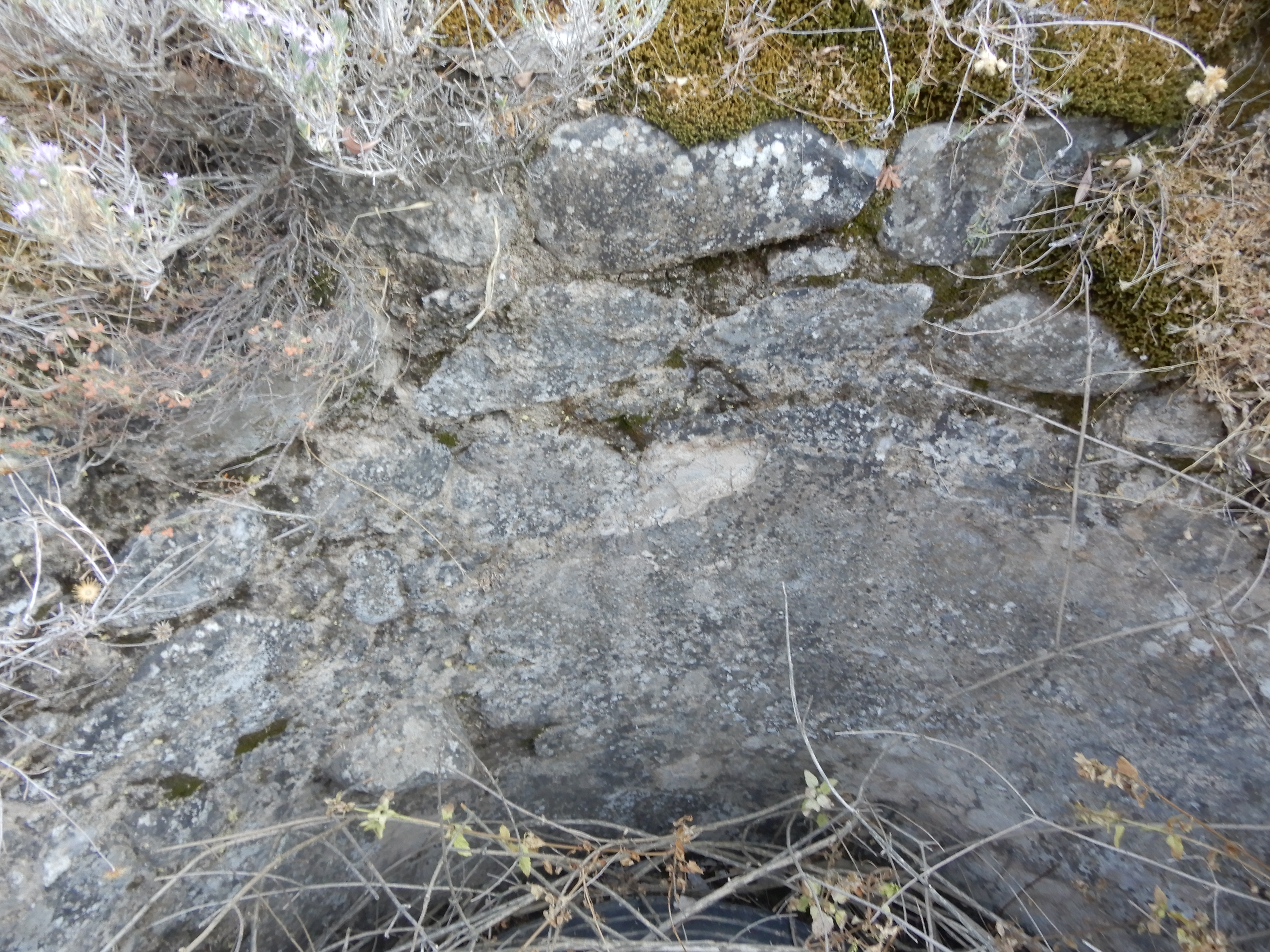
The only structure of the mill that is still visible is a part of the watertower, which is rectangular in plan, while its opening has the shape of an inverted truncated pyramid. The watertower measures 2.80m in length and 3.50m in width and it is built with river pebbles combined with limestone. Presumably, the materials, especially the limestone were procured from the area. The interior surface of the tower is plastered. Two mortar samples from the watertower were collected and examined, in order for them to be characterized. The first sample is a plaster from the interior surface of the pit (MAL 2-1) and the other one is a joint mortar from the watertower (MAL 2-2). The following analytical methods were used for the examination of the historic mortar samples: Thermal analysis (DTA-TG), and X-ray diffraction (XRD). The samples are identified as lime mortars with calcite, feldspars and often quartz aggregates. One of the samples (MAL 2-2) contains ceramic fragments in various sizes and shapes, along with ceramic powder, contributing to adhesion, impermeability to water and resistance to continuous contact with humidity (Corti et al. 2013: 75). Both mortar samples are considered as strongly hydraulic or with some hydraulic characteristics. While the construction date remains uncertain, the last miller Nikoladjis of Malounta, was operating the mill in the end of the 19th century. It is possible that the name of the watermill is associated with the profession of the last miller, who was a baker, known also in the Cypriot dialect as ‘madjipas’ (Lapithiotis et al. 2017: 12). Pandeli 14859002077720Fig.1: The location of the watermill of Madjipas in Malounta, Nicosia. (Department of Lands and Surveys). 14859002077720 83821285750 27994711951143001747520Fig.2: The location of Madjipas watermill in Malounta, Nicosia. Aerial Photograph of 2014. (Department of Lands and Surveys). 114300174752028448001747520Fig.3: Madjipas watermill in Malounta, Nicosia today. (Personal Archive). 28448001747520 1021963462659380571 215900680720Fig.4: The water tower of Madjipas watermill.(Personal Archive). 215900680720 2743200109220Fig.5: Madjipas watermill from above. (Personal Archive). 2743200109220 Bibliography: Carvalho et al. 2018 = Carvalho, F., Lopes, A., Curulli, A., Silva, T.P., Lima, M.M.R.A., Montesperelli, G., Ronca, S., Padeletti, G., and Veiga, J.P. (2018). ‘The Case Study of the Medieval Town Walls of Gubbio in Italy: First Results on the Characterization of Mortars and Binders’, Heritage 1, pp. 468-478. Corti et al. 2013 = Corti, C., Rampazzi, L., Bugini, R., Sansonetti, A., Biraghi, M., Castelletti, L., Nobile, I., and Orsenigo, C. (2013). ‘Thermal analysis and archaeological chronology: The ancient mortars of the site of Baradello (Como, Italy)’. Thermochimica Acta 572, pp. 71-84. Lapithiotis et al. 2017 = Lapithiotis, P., Evaggelou, Ch., Aristidou, A., Ioannou, M., Pilava, M. (2017) The watermills on the Serrachis River in the Vartalis area. Nicosia: B’ Regional High School Nicosia – Malounta [Unpublished Paper]. Archive: Department of Lands and Surveys
Photos
-(1).JPG)
Malounta 2nd mill (tou Madjipa) (1).JPG
-(2).JPG)
Malounta 2nd mill (tou Madjipa) (2).JPG
-(3).JPG)
Malounta 2nd mill (tou Madjipa) (3).JPG
-(4).JPG)
Malounta 2nd mill (tou Madjipa) (4).JPG
-(5).JPG)
Malounta 2nd mill (tou Madjipa) (5).JPG
-(6).JPG)
Malounta 2nd mill (tou Madjipa) (6).JPG
-(7).JPG)
Malounta 2nd mill (tou Madjipa) (7).JPG